Kabra Extrusiontechnik had a bad FY12 financially due to slowdown in Indian polymer consumtion growth. Construction pipes and FMCG packaging oriented polymer consumption is expected to resume it's growth in FY13 and so the growth of Kabra Extrusiontechnik. Does this makes it a stock to buy in 2012?
BUSIENSS
As stated, The polymer consumption in plastic pipes for irrigation, water management, construction, telecom industries and packaging films for edible oils, milk, processed foods and other FMCG products is expected to show healthy growth in FY13 and beyond. Kabra Extrusiontechnik (KETL) is India's leading manufacturer of heavy machinery/plants for plastic processing industry to produce plastic pipes and packaging films. The expected growth will ensure demand for products of company.
Industry experts believe that investment of nearly $10 billion would be required in the plastic processing industry to meet the future demands. Such big investments in the plastic processing industry will be a key growth driver for sector and so for the company.
The company has set up one more manufacturing unit at Daman with investment of Rs.35 crores for new products. This additional capacity will be available from FY13 onwards.
Kabra extrusion has paid dividend consistently for last 7 years in a row. It's current stock dividend yield stands at healthy 5.17%.
STOCK FINANCIALS
KETL's profits plunged 75% against a 14% fall in its net sales in first three quarters of FY12. This was due to investment in new plant in Daman and increased expenditure due to hike of 30% in local electricity rates. Company's revenues have grown at a CAGR of 16.9% with profit growth at 32.5% in the five-year period ended FY11. Its debt-equity ratio at end September 2011 is at 0.1.
STOCK VALUATIONS
The stock trades at current stock price of Rs.34. The price-to-earnings multiple (P/E) is at 11.67 and price-to-book value ratio (P/BV) of 1.01. The board has recommended dividend of Rs. 1 per share for 2012 which makes dividend yield at 3% which is not bad. Looking at growth prospects and limited downside, it is a good small cap stock to buy at dips and wait for a year or two to get good investment returns.

Showing posts with label Value Stocks To Buy. Show all posts
Showing posts with label Value Stocks To Buy. Show all posts
Selan Exploration : Stock to buy in 2011
I had published a post Selan Oil Exploration: Soaked in Crude almost three years back as stock analysis for investment. It was at Rs. 150 at that time. The stock trades at around 400 now. I just thought to research a bit on it for current scenario and I found it recently recommended as multibagger stock to buy in 2011 by Ashish Chugh on CNBC-TV18. Let's see what he says.
Ashish Chugh believes that even at the current price this stock may turnout to be a potential multi-bagger stock.
The financials of Selan Exploration for the past two years have been almost flat. There was not much increase in either production. This is mainly because of the fluctuating oil prices. The revenues and profits are inline with the oil prices but there has not been any substantial increase in production in the last two years.
Selan exploration is doing 3D contour mapping for past 2 years of not just the Bakrol field, which is giving them major production as of now but for some other fields also. The new technologies which are available enables the company to identify the reservoirs where if drilling is done will give them about 10-15 times more oil than what the current wells are producing.
To calculate roughly, the company is doing about 2.5 lakh barrels every year from about 20 wells, which means that each well is giving them close to 12,000-13,000 barrels, and the new wells are capable of producing 1-1.5 lakh barrels per year, this could translate (if the company starts drilling two new wells) to double their production.
If company starts drilling wells in next 3-6 months, 10 wells would almost quadruple their oil production. This thing may get start reflecting in the company’s topline and the bottom line in probably year 2011-12. If you see the valuations at which the recent deals have taken place, if you look at Cairn-Vedanta deal, if you apply just 50% of that valuation to only the Bakrol field where we have the data for 2P reserves you get a mind boggling figure.
At the current valuation it may just be a fraction of the valuation for the Bakrol field and leave aside the other fields which are still virgin where no data has been declared and I believe this is a stock where institutional investors will find value even when the stock goes to four figure mark because by that time the production would have got ramped up significantly. Probably the 2P reserves data for the other fields might also get announced by the company and the financial numbers would start looking a lot better than what they are now. This is a company where the drilling is happening or the production is happening just in one field, which is a Bakrol field—operating margins are anywhere between 80-85%.
Once the ramp-up happens and with oil prices being steady and at higher numbers, I think this maybe a stock to watch out for in the years to come. The only thing is that as of now there are a few unknowns; the first is that when they start drilling is something, which nobody knows about but I believe that since they have already spent about two years in data acquisition drilling can happen in the next probably three to six-months. Oil exploration by nature is a risky business but I think the risk is getting mitigated because of the fact that all the fields are proven fields. So, in the years to come, we may see a massive scale up in the production of the company. This makes Selan exploration a stock to buy or at least a stock to watch out for, for the future.
Any correction in stock price towards Rs. 350 would definitely be a nice opportunity to buy stocks of Selan exploration.

Stock To Buy Now - Noida Toll Bridge Company
I had recommended to buy stocks of Noida Toll Bridge Company earlier this year as well as in year 2009 from long term perspectives. It is definitely a stock to buy now looking at the valuations it is available at.
Business: Noida Toll Bridge company was promoted by Infrastructure Leasing and Financial Services Ltd. (IL&FS) as a special purpose vehicle (SPV) to construct, operate and maintain the Delhi - Noida Bridge on a Build Own Operate Transfer (BOOT) basis. The Delhi Noida Bridge is a tolled facility connecting Noida to South Delhi across the Yamuna river. The Company's principal source of revenue is from the levy of tolls on commuters on this facility.
Outlook: It should be prudent to note that the company's operating income comprises revenues from the toll it collects and hoardings/advertisements on the routes it has developed.The outlook for growth in traffic on the Delhi Noida Bridge is very positive. Traffic levels on the Delhi Noida Bridge are expected to increase as Noida and Greater Noida experience development and population growth. In their review, Halcrow Consulting estimate that by 2021 the population of Noida and Greater Noida areas will increase by 2 million and the daily vehicle trips on the Delhi Noida Bridge will increase to 200,504.
The company has set up a 100% subsidiary, DND Flyway, for the implementation of development rights. Part of the surplus land on the Noida side has been transferred to the subsidiary. These projects have thrown up fresh opportunities for NTBCL.
All this development could fetch huge returns for company and shareholders. Company's current valuation stands at Rs. 11 Billions. This calculates per share cost as on today at Rs. 55-60 and qualifies it as a stock to buy now.
Company has contract with NOIDA to recover the original total cost of project PLUS 20% returns on total cost of project. If in certain financial year, company can not achieve 20% returns due to lower traffic, the shortfall amount would be added to total cost of project which would form the new total cost of project as base cost for next years calculations. NTBCL’s annual report says this amount is Rs. 17 Billions. That comes at Rs. 91 per share. Although NOIDA would not pay it in cash to company, there is a provision in agreement that company has rights to operate the bridge and collect toll till company does not recovers this shortfall. Company management has estimated that it would take 70 years to recover all the shortfall of past and future!
The longevity of business is more than lifetime of a human being and that too assured one. Intrinsic value is very good which makes it a stock to buy. The assurance of income in the form of toll fees is there to remain. Company has all rights to increase toll rates in accordance with inflation rate with approval from NOIDA. Toll rate hike was not approved by NODIA due to recession in 2009, which is going to be reviewed soon by approximately 20% in near future.
Company has paid dividend of 0.50 paisa/share in 2010 which makes dividend yield at 1.5%. This should increase in future.
All in all, NOIDA Toll Bridge Company is a stock to buy now for long term. I would advice you to buy stocks of this company for at least 5 - 10 years.
P.S. I have used this bridge many times and it is truly a world class construction. I have seen the land around it and I consider it personally as one of the most prime land in Delhi and NOIDA area.
Disclaimer: I am buying stocks of NTBCL at CMP.
Stocks To Buy For Your Investment Portfolio
Here are few stocks discussed by Rajen Shah of Angel stock broking on one of the business news channels. He has been advising investors to buy stocks discussed here for investment portfolio since long time.
Mid Cap Stock To Buy - MRF
A number of auto badgers are coming to India, Volkswagen has recently started, Nano is commencing operations in the next one-month from the Sanand plant and MRF is an exclusive supplier of small tyres. I am looking at very good times ahead for tyre industry and it is going to be there. So I don’t think I am worried about that Rs 150 per kg of RSS IV grade rubber which is used in the manufacturing of tyre. MRF should report easily Rs 900 kind of earnings and it is at 8 P/E multiple.
Large Cap Stock To Buy - ITC
Interesting things are happening in ITC. If you see the segment wise result, tobacco business reported almost 16% kind of an improvement in the bottomline in the last quarter and it is growing in double-digits. If you see the bidi market in India, it is three-four times the cigarette market. With more income in the hands of rural India, anybody would like to upgrade from a bidi to cigarette. This prosperity of India which is going to take place because of the economic growth is going to lead to double digit volumes growth in case of the cigarette business. That is one thing.
Mid Cap Stock Analysis - Ballarpur Industries Limited (BILT)
There were at least 4-5 reasons why we like this stock and one of them was two years back this company had bought back 38 crore shares at an aggregate price of Rs 25 pumping in Rs 940 crore. When a management is pumping in Rs 940 crore, which is one of the highest buybacks in the history of the Indian corporate sector, one shouldn’t have been bearish on this stock at all.
Mid Cap Stock Analysis - Ballarpur Industries Limited (BILT)
This is one of the 3 stocks for investment portfolio recommended by Rajen Shah, Angel stock broking.
Here are excerpts of his discussion on one of the business news channels.
At every investor camp at around Rs 24-25 levels, we have been recommending this stock very strongly. There were at least 4-5 reasons why we like this stock and one of them was two years back this company had bought back 38 crore shares at an aggregate price of Rs 25 pumping in Rs 940 crore. When a management is pumping in Rs 940 crore, which is one of the highest buybacks in the history of the Indian corporate sector, one shouldn’t have been bearish on this stock at all. The stock did underperform significantly but then there was sheer value rate and it was just a matter of holding on to the stock and the gains were sure to follow. Now the gains are sure to follow from hereon.
The other interesting thing which happened in the last two months is that promoters have subscribed to about 10 crore shares—about 5.5 crore shares and about 4.5 crore warrants. This will increase the stake from 40% presently to about 49% in about 18 months and they are subscribing to this 10 crore share at an aggregate price of about Rs 30 pumping in Rs 300 crore. So when the management is buying back shares worth Rs 940 crore, pumping in 300 crore to scale up their holdings from 40% to 49%, I think that is no reason why we should doubt that the stock is overpriced or is going to languish.
One needs to get into it and hold on and the gains are sure to follow. Other interesting thing is that at a price of Rs 25 and even at the current price of Rs 32, Ballarpur is a one million tonne paper plant, you are getting it for about Rs 1,780 crore. If you were to set up a similar plant like Ballarpur with a capacity of 1 million tonne, you would require nothing less than Rs 3,000 crore. On a replacement value also you are getting it for about Rs 1,200 crore less than what otherwise would have been required for setting up a plant like Ballarpur.
Interestingly, what has happened is, in the first five decades, ever since Ballarpur commenced operation, the total capacity of Ballarpur was about 6 lakh tonne and over the last three years, they have almost doubled it to about 1 million tonne.
Hence huge investments went into this raising of the capacity from 6 lakh tonne to one million tonne and hence the interest cost went up, in the last quarter and the quarter prior to that we have seen depreciation going up. Now that this one million tonne capacity is into the market and with the paper prices doing very well—paper prices have moved up about 12.5% over the past six-seven months—this company is sure to encash on the increased capacity which is now coming into the play.
So interesting would be June 2011 and not June 2010—2011 it can go to the extent of reporting Rs 4.5 kind of earnings. We have a target of about Rs 45 in a year’s timeframe and maybe I think it could even go higher from those levels of Rs 45 but that depends upon how the company does perform in coming three-four quarters which we are looking at very keenly.
Go back to >> Stocks To Buy For Your Investment Portfolio
Top Sectors And Best Stocks To buy
Recently I heard Ramdeo Agrwal, Director & Co Founder of Motilal Oswal Financial Services, talking on top sectors and best stocks in those sector to buy now. He believes in value investing and opines that there are lot of investing opportunities.
Midcap banks and cement sector are the ones he thinks could make it very good providing value investors lot of opportunities.
He also thinks two wheeler market has huge opportunities with very few players tapping the entire two wheeler market. In fact there are only two market leaders in this industry, Bajaj Auto and Hero Honda. These 2 companies are clearly winners with no other big competitors in markets. 9 out of 10 bikes sold in India belong to either Bajaj Auto or Hero Honda.
Read: Stocks To Buy In 2010 - Let's Share Ideas
To counter the question on any growth left for Indian Bike makers, He gave example of sheer size potential in China — they do almost 35 million motorized-cum-electric bikes in China every year. India do about 9.5-10 million. So the potential to grow and the size of the market which can be for two-wheelers for our country, which has USD 1,100-1,200 per capita income, is very large. It also has to cater to the replacement market demand.
Everyone in India can not afford to buy a four wheeler. Although there are smaller cars being launched like Nano, the maintenance expenses and running costs are high for common man. With fuel prices going northwards all the time, it would be difficult for middle class to use four wheeler.
What we have to focus on is not the size of the opportunity. He thinks in India everything will grow. What is important is how many players are going to share that particular opportunity and in two-wheelers there are only two; we are just talking about Hero Honda and Bajaj Auto who are going to take about 80-85% of market share.
There is a reasonable race in the valuations and in India value doesn’t exist without growth. So one has to calibrate quality of growth at expected growth levels and see how exactly it plays out in the current valuation. So a growth stock could be a very good value in Indian context of value investing.
Source:CNBC-TV18 & Moneycontrol
You may want to read: Stocks To Buy Now For 2010 Investment Portfolio
Tulsyan NEC - Small Cap Value Stock To Buy
This is second of the small cap stocks to buy in 2010 recommended by Ashish Chugh in his recent comments on CNBC-TV18 channel.
This Company is listed on BSE as well as NSE. It got its listing permission from NSE a couple of months back. This is a company, which is in two lines of business: Steel and woven sacks. The company manufactures TMT bars, MS alloys and billets in the steel division. They also manufacture HTP and PP woven sacks. Tulsyan NEC is not ideally one of those steel companies which you would want it to be in terms of backward linkages. The company as of now doesn’t have any backward linkages. It buys steel scrap/sponge iron for manufacture of steel and it also buys power from the grid. It doesn’t have its own captive power source.
But if you look at the other positives of the company, this company is available at a market cap of just about Rs 33 crore. The company does sales revenue of about Rs 650-700 crore. This company has been a profit making company for the past 15 years. It has made profit not just at the operational level but also in the net level in the last 15 years. The company has got a track record of dividend for the last ten years which is uninterrupted – even during the worse phases of the steel cycle this company has paid dividend in the last 10 years.
The company made an operating profit of about Rs 46 crore last year and operating profit for the first nine-months is about Rs 31 crore. PAT for first nine months is about Rs 4.5 crore, which results in an annualized EPS of about Rs 12. At the current price of about Rs 65 this stock is trading at a PE multiple of about 5-6.
The other good thing happening here is that the company is now going in for backward linkages, about 2-3 months back this company has acquired a sponge iron plant called Chitrakoot Steel and Power Limited, which has got a 30,000 tonne per annum for sponge iron capacity, which they are increasing further to about 1 lakh tonne per annum. The company is also putting up a 35 megawatt power plant. They have already acquired about 75 acre of land. This will be operational in Q3 2011, which is FY12.
Considering all this, the company had been making good profits for the past 15 years without any backward linkages. Now the backward linkages are coming. The market cap of the company is just about Rs 33 crore – even assuming a 1% increase in net profit margins on a sales of Rs 700 crore results with an EPS increase of about Rs 14.
Of course, this is not an ideal steel company in terms of linkages but its available at a market cap just about Rs 33 crore on sales of Rs 700 crore. The downside from these levels looks extremely restricted but once the linkages are there, obviously, the profitability will go up. Also there is a potential for huge upscale increase in profits after the linkages are available.
So at the current price of Rs 60-65 I think it’s a stock to buy for the next maybe two years. Once the linkages are in place the profits can go up really sharply.
Disclosure: Analyst, Ashish Chugh has investments in Tulsyan NEC
Checkout more small cap stocks to buy in 2010
Small Cap Stock To Buy - Orient Ceramics
Here is one of the small cap stocks to buy in 2010 recommended by Ashish Chugh in his recent comments on CNBC-TV18 channel.
Orient Ceramics is a Delhi-based company manufacturing ceramic tiles. This company has got its manufacturing plant located in Secunderabad in Uttar Pradesh. Off late the company has been doing lot of initiatives to increase the market share. The company has introduced new ranges of tiles. These new ranges have got good response from the market.
The company is planning to open more retail stores and also have larger distribution network of distributors and retailers in various cities where they are currently not present. The third thing is that the company has also decided to start retailing of other construction related items, which makes it a one stop shop for all construction needs.
On the financial side:
For FY09 the company achieved sales of about Rs 225 crore and made Rs 6.4 crore in profit after tax (PAT), which results in an EPS of about Rs 6-6.5.For the first nine-months of the current financial year, sales are at Rs 175 crore. The PAT is up by 35% to about Rs 6 crore. For full year, expected sales are around Rs 250 crore with a PAT of Rs 8.5 crore, which results in an EPS of about Rs 8. At the current price of about Rs 45, the stock is trading at a price to earnings multiple of about Rs 5-6.
Market Cap 53.60
* EPS (TTM) 7.55
* P/E 6.74
* P/C 2.89
* Book Value 49.86
* Price/Book 1.02
Div(%) 15.00
Div Yield(%) 2.95
Market Lot 1.00
Face Value 10.00
Industry P/E 8.26
This is a full tax paying company. The company pays tax with no concessions. If you look at the market cap of the company this company has a market cap of about Rs 45 crore. Sales is Rs 250 crore and cash profit is Rs 20 crore, which means it is going at less than two-and-a-half year’s of its cash profit.
This company has a dividend history of the past 20 years. Only during 1993 it skipped dividend. Otherwise from 1990 to 2009, the company has been regularly paying dividend. Considering all these factors at the market cap of about Rs 45 crore the stock qualifies as a value stock to buy. It is a good investment from 1 - 2 years perspective.
Checkout more small cap stocks to buy in 2010
Small Cap Stock To Buy - Banswara Syntex
Banswara Syntex is a good stock to buy on dips given the company’s wide product portfolio and its focus to grow the niche textile products. I would like to include this stock in our series stocks to buy in 2010 - Let's Share Ideas.
A 33-year-old integrated textile manufacturer, Banswara Syntex has benefited the most during the recent run in stocks of some of the integrated textile manufacturers. The company experienced a jump in its operating margins in the current financial year due to improved exports while rising prices of yarns have also supported the margins in the latest quarter.
COMPANY:
Banswara Syntex is a Rajasthan-based blended yarn and fabric manufacturer. The company manufactures all types of blended yarns, namely polyester, viscose, woolen and acrylic other than cotton. It also manufactures fabrics and garments on made to order basis and supplies them to all top retail brands. Banswara has entered into a 50% joint venture with French textile company Carreman for a weaving plant of 60 looms. The company has started production of technical textiles while it also manufactures Lycra branded fabrics especially for women fashion clothing, women office clothing and school uniforms.
The fabric business is currently the larger contributor to the total revenue, with more than 60% of sales coming from the segment. The rest 40% to the topline is contributed by the yarn business, a major chunk of which comes from the sale of polyester yarn. The company exports its products to nearly 50 countries and exports accounted for nearly 60% of revenue in the current quarter. Banswara has coal-based and furnace oil thermal power-based power plant with a capacity of 18 MW (mega watt) and 9 MW respectively, both of which are used for captive consumption of power. The company has planned for an additional 15/18 MW thermal-based power plant, which is expected to commence operation at the end of ‘10.
FINANCIALS:
In the last five financial years, the company’s topline grew at a compounded annual growth rate (CAGR) of 21% while net profit increased with a CAGR of 40%. The revenue experienced a big push in FY10 thanks to a substantial demand recovery in the March ‘09 quarter. On a trailing year basis, while the improvement in profit margins continued during the latest four quarters, the interest cover has improved in the last two quarters. This is in line with a decline in the interest cost (from 5.9% to 5.1% of net sales) in the latest two quarters on a trailing year basis. While a high debt to equity ratio (4:1 for FY10) is a concern, the growth in debt is accompanied by a similar expansion in the gross block. The company has a capex plan of Rs 110 for the next financial year, about one-third of which is to be resourced through internal accruals, and the rest through term loans. The funds are to be used for construction of another power plant and modernisation of the current production facilities.
GROWTH DRIVERS:
The company expects to further bank on its fabric line of business by focussing on niche market products like Lycra and technical textiles. In recent months, it has received an initial order of 57,000 metres of three-layer waterproof breathable fabrics from ministry of defense and a third repeat order of 20,000 metres of technical fabric from a US-based customer. Banswara has planned for an additional 15/18 MW thermal based power plant which is expected to commence operation at the end of 2010. The power generated by this plant would primarily be used for internal consumption and surplus for sale.
Market Cap 141.68
* EPS (TTM) 24.72
* P/E 4.37
* P/C 2.29
* Book Value 68.16
* Price/Book 1.59
Div(%) 18.00
Div Yield(%) 1.67
Market Lot 1.00
Face Value 10.00
Industry P/E 158.25
STOCK VALUATIONS:
The stock has demonstrated an outstanding performance not only against the Sensex but also among all textile companies. Against a 75% gain in the Sensex, the market-cap of Banswara experienced a six-fold jump. At the current market price, the PE ratio stands at 4.5, lower than its average for the last five years and closer to the average of the last two years. The stock is a good stock to buy with intrinsic value on dips given the company’s focus to promote its niche textile products.
Source & Reference: ET Investor Guide
Andhra Cement - Safe Value Stock
Investment analyst, Ashish Chugh has recommended to buy stocks of Andhra Cement in his stock analysis report. This article is from series "Stocks To Buy Below Rs.50 in 2010"
We like Andhra Cement because of the capacity expansion, which is going in the company. This is a GP Goenka group company, which has got two cement plants with a total capacity of 1.4 million tonne per annum. In FY09, this company achieved a sales of close to Rs 370 crore, profit after tax (PAT) was about Rs 60 crore, which results in an EPS of about 4.5. At the current price of about Rs 28, stock is traded at a price to earning multiple of about 7.
Now this company is undertaking a capacity expansion, which will take its capacity from 1.4 to 3.5 million tonne per annum. The increased capacity is going onstream in the next couple of days – maybe next week as what GP Goenka mentioned in a recent interview with CNBC-TV18.
So you have a company which is available at a price to earning multiple of about 7 on the old capacity and with the new capacity going onstream next week, which is going to potentially add the turnover by 2.5 times since the capacity is going up from 1.4 to 3.5 million tonne per annum, I think at the current market cap of about Rs 350 crore and the current P/E of 7, the stock is undervalued.
Another thing is that promoters have been increasing their stake in the company through market purchases and there has been a lot of inter state transfer between the promoters also. So promoters also realize the potential of the company and heartening fact is that the promoter’s stake in the company is close to 75%. So over the next few years, there is potential for dilution.
I see Andhra Cement is one of those candidates where potentially since there is a lot of interest in the cement companies from foreign players, there could be some kind of a strategic investor coming into the company or maybe some majority stake being given to some potential investor. Andhra Cement maybe a fit case where those possibilities exist.
Fundamentally, also at a price to earnings multiple of 7 on 1.4 million tonne capacity, of course, earnings are going to grow up when the expanded capacity goes on-stream. So at Rs 28 again, this is a market where midcaps and smallcaps have run away quite a bit.
To look for a safe stock in this kind of a market is slightly difficult. Andhra Cement at Rs 28 looks to be a stock where the downside looks restricted even if the market falls. And since the earnings are going to rise in the coming years, there is scope for significant appreciation from these levels.
Disclaimer by Ashish Chugh
It is safe to assume that my family and I may have a holding in the stocks discussed.
Go back to series "Stocks To Buy Below Rs.50 in 2010"
IFGL Refractories - Value Stock
Investment analyst, Ashish Chugh has recommended to buy stocks of IFGL Refractories in his stock analysis report. This article is from series "Stocks To Buy Below Rs.50 in 2010"
IFGL Refractories is currently trading at a price of about Rs 48-49. This is a refractory company based in Orissa. Besides the plant in Orissa, this company has got two major subsidiaries called Monocon International and Hofmann Ceramics. In total this company has got manufacturing operations in seven countries. Now, 2008-2009 was a difficult year for this company mainly because of the fact that the steel industry saw a meltdown and the steel industry biggest customers. As a result of which the second half of the company was not that good. The company suffered losses in the second half of 2008-2009.
In the first half of the current financial year company has achieved a profit of close to Rs 17 crore. We have been recommending the stock on CNBC-TV18 earlier also but what reinforces your liking for the stock is the recent interview, which the management of the company had on your channel about a few days back now. They mentioned that the second half of the current financial year can be substantially better than the first half. We also believe that the worst maybe over for the company.
The company, which had installed its expansion project at Kandla, has now restarted that project. That project will add about Rs 150 crore to the revenues and that will become operational in 2011 and besides this, the company also looking for more overseas acquisitions. Now because of the company’s organic and inorganic expansion projects, which are going on, company has the potential to become a significant player in the world refractory market over the next couple of years.
So at the current market cap of about Rs 150 crore and price-to-earning of about 4-5, we do not see too much of downside from these levels. At a PE multiple of 4-5 the stock looks undervalued.
Go back to series "Stocks To Buy Below Rs.50 in 2010"
Bajaj Holdings - Stock To Buy With Intrinsic Value
Here is another stock to buy in 2010. Bajaj holdings is basically the investment and treasury division of the two-wheeler major Bajaj Auto.
Vishal, one of our fellow investors and Indian Stocks News reader had suggested this company in comments section in article "Stocks To Buy For 2010 - Let's share Ideas".
A bulk of Bajaj Holding's equity investment is represented by its holding in Bajaj Auto, Bajaj Finserv and ICICI Bank. However, there have been some fundamental changes in the company’s functioning, after its demerger. Unlike in the past, the company now actively manages its investment portfolio which means regular buying and selling of securities to take advantage of market fluctuations. In that sense, buying stocks is akin to investment in a close-ended fund. While equity investments constitute two-thirds of the total investment book, debt, mutual funds form the remaining part.
The company has posted impressive numbers in the first half of the current fiscal. Its profit grew by 254% year-on-year in the six months ended September 2009. Such high growth in profit was due to current rally, as the company’s fortunes are directly linked with the asset markets. The company earned Rs 435-crore profit from sale of investments in the first half of the current fiscal compared with a mere Rs 3 crore in the corresponding period last year. Huge trading gains also show the company’s efficient portfolio management.
Institutional investors like LIC, ICIC Prudential Life Insurance and Birla Sun Life Insurance have stakes in the company. In fact, institutional investors have increased their stake in the company in the past one year. For instance, ICICI Prudential Life Insurance had a 2.7% stake in September 2008, which it has increased to 4.7% in September 2009. Similarly, Birla Sun Life Insurance didn’t have a stake last year, while it owned 1.2% of the company at the end of September 2009. This shows that institutional investors are showing more confidence in the company now.
The per share value of investments made by the company turns out to be Rs 1,422. However, the stock is trading at just Rs 609 per share. This shows that the stock is trading at significant discount to the value of investments. Its shares are trading at a price-to-earning multiple (P/E) of around 10, while Tata Investment Corp, which is in similar business, is trading at 15 P/E. The stock is not only trading at a discount to its value of investments, but also with regards to its peers, and hence, there is scope for further price appreciation.
Source:Economic Times
This article is part of the series "Stocks To Buy For 2010 - Let's Share Ideas". You can find updated list of other articles in this series, as and when published, here.
You may subscribe to Indian Stocks News RSS Feeds to get the post updates directly in your mailbox and do not miss on this.
Small Cap Cement Sector Stock To Buy - Mangalam Cements
The Mangalam Cement stock is possibly one of the cheapest in the cement sector right now, trading at just 2.6 times its trailing 12 months earnings. Also, the stock trades at just 1.2 times its book value for the year ended March 09, coupled with a high dividend yield of 4.6%. This stock provides an attractive investment opportunity as one of the long-term investments.
 MANGALAM Cement part of the BK Birla Group has grown aggressively over the past three years, thanks to robust demand conditions. Kumarmangalam Birla, who will inherit BK Birla controlled Kesoram Industries and Century Textiles, will own a 17.7% stake in Mangalam Cement via these entities and account for a significant portion of the promoter holding.
CAPACITY & EXPANSION PLANS
Mangalams capacity was 2 million tonne at the end of FY 09, double the level from two years ago. The company invested Rs 198.6 crore as capex during this period and its cash flow was Rs 277 crore. Despite the capex, Mangalam Cements leverage ratio was just 0.17 at the end of March 09, compared to 0.48 two years earlier.
Its key markets are Rajasthan, UP and Delhi, where demand conditions have remained strong thanks to governmentfunded projects and rural housing projects, and price realisations have also remained higher on a y-o-y basis. The board of Mangalam Cement had earlier given its in-principle approval for setting up a new cement plant with a capacity of 1.5 million tonne at its existing plant site in Rajasthans Kota district. In addition, the company plans to set up a captive power plant with a capacity of 17.5 MW, for which it has placed orders.
The cost of this expansion project is estimated at Rs 750 crore, which would be financed via internal accruals to the tune of Rs 300 crore and the remainder by debt. Given the strong cash flows of Mangalam Cement, financing this project over the next two years should not be a problem.
FINANCIALS
The companys operating profit margin rose by 1,460 basis points y-o-y to 36.2% in the September 09 quarter, helped by its realisation that improved an estimated 23.2% y-o-y to Rs 3919 per tonne. However , the companys total despatches declined 2.1% y-o-y to 423,000 tonne in the second quarter of FY 10.
Compared to its peers, Mangalam Cement has handled its operational costs quite efficiently. For instance, in the year ended March 09, the company spent nearly Rs 831 per tonne on power & fuel costs. The corresponding figure for Shree Cement and JK Cement was Rs 781.6 per tonne and Rs 1,000 per tonne, respectively, for FY 09. Also, while Mangalam Cement has reported a decline in its power cost over last three years, its other two peers have reported a rise.
Market Cap: 336.61
EPS (TTM): 46.76
**P/E: 2.70
P/C: 2.26
* Book Value: 107.79
* Price/Book: 1.17
Div(%): 55.00
Div Yield(%): 4.36
Market Lot: 1.00
Face Value: 10.00
Industry P/E: 9.20
 VALUATIONS
At Rs 120.4, Mangalam Cement trades with a P /E of just 2.6 times its trailing earnings. Binani Cement, on the other hand, trades at 5.4 times while JK Cement trades at 3.9 times. It's CMP is close to book value making it a value stock.
Mutual Fund, SBI Magnum Emerging Businesses Fund (Growth), holds stocks of Mangalam cement in it's portfolio.
Considering all valuations and growth opportunities due to reviving demand from infrastructure sector, Investors may buy stocks of Mangalam Cement as long-term investment.
Source: I have used excerpts of article from ET Investors Guide along with my comments and other information.
Mid-day Multimedia - Stock Analysis & Recommendation
 Mid-Day Multimedia Limited operates as a media company in India. It owns and operates various community newspapers, including Mid Day and Sunday Mid Day for English readers, Gujarati Mid Day, and Urdu daily Inquilab. The company also operates Radio One 94.3 FM with stations at Ahmedabad, Bangalore, Chennai, Delhi, and Pune.
In addition, it engages in outdoor advertising business. Mid-Day Multimedia Limited is based in Mumbai, India. Rakesh Jhunjhunwala, an iconic investor in Indian stock markets pocketed around 5% stake in the counter at 40 odd rs. Sensex moved five times since then, many scrips became huge wealth creators, people made fortune but mid-day never moved.
Market Cap 127.07
* EPS (TTM) 0.63
* P/E 38.17
* P/C 29.69
* Book Value 30.60
* Price/Book 0.79
Div(%) 0.00
Div Yield(%) -
Market Lot 1.00
Face Value 10.00
Industry P/E 32.30
The stock is trading at higher P/E levels but it is available below it's book value which is indication of a value stock.
Rakesh Jhunjhunwala is holding the stock even now which shows his confidence and conviction in the company. Media sector is a sun rising sector with immense potential and opportunities. With RJ still backing it I feel mid day is a stock to buy which has little downside from around 20 levels but can be a multi bagger in long run.
Small Cap Stocks To Buy - Hidden Gems From Ashish Chugh
2 - 3 days back I came across two stocks to buy in this Diwali by Investment analyst Ashish Chugh who is an author of famous book "Hidden Gems". Both the stocks are small cap stocks and according to Ashish Chugh, these stocks have hidden intrinsic value which could fetch good returns of investment in long term.
He is bullish on Visaka Industries, a rural infrastructure deelopment company and Deccan Gold mines, only stock market listed gold exploration and gold production company in India.
Both the stocks are pure intrinsic value stocks play and both can provide good returns of investment with long term strategy.
Both the small cap stocks have run up a lot in past few months and it is advisable to not to buy right away but to buy when in corrective mode and be there as long term investor.
Checkout the detailed recommendations for both the stocks:
Small Cap Stock To Buy With GOLDen Touch - Deccan Gold Mines
Small Cap Stock With Good Dividend Yield - Visaka Industries
Both the small cap stocks have run up a lot in past few months and it is advisable to not to buy right away but to buy when in corrective mode and be there as long term investor.
Small Cap Stock To Buy With GOLDen Touch
Deccan Gold Mines is the first private sector gold mining company and rather the only gold mining company listed on the Indian stock exchanges. The company has got blocks spread across four states. The total area of the blocks is more than 10,000 sq kilometers.
Talking of gold mining business, gold mining company has to pass through three stages before they can commercially start mining gold. The first stage is called reconnaissance permit where they seek the approval of the authorities to do exploratory activities on say 200-300 sq kilometer of the block. Second stage is prospecting license wherein they short list about 25 sq kilometer or 30 sq kilometer out of the total area where they would like to do the further exploratory studies and the third stage is called mining lease where in they short list about half a sq kilometer or one sq kilometer where they would actually like to drill and take gold out or rather rock out and then refine it and produce gold.
The company has filed application for about six blocks for mining license. As per the management the actually mining of the company is expected to start in the last quarter of FY10-11 which is January to March of FY11 and if you look at the valuations of this company as of now the company has got zero revenues. It has a market cap of Rs 200 crore but going by what the management has been saying that. Management says that they are able to derive about 4 tonne of gold per annum assuming on a conservative basis that they are able to do only 2 tonne and taking a price of about Rs 15,000 per ten grams this would translate into revenues of about Rs 300 crore. Typically internationally the gold exploration cost is about USD 350-400 per ounce which in this case will translate into Rs 5000-5500 per ten grams.
Assuming initial expenses to be high we still believe that on a conservative basis the operating profit of the company could be in the region of 40-50% which means on a revenue of about Rs 300 crore the company can do about Rs 120-150 crore of operating profit so as of now there are no profits but market cap is only Rs 200 crore which is less than 2 years of the companies operating profit. The valuation is low mainly because of two reasons. One is the uncertainties involved in the business and also the uncertainties with regard to the regulatory clearances for this company. The second relates to the psychology of the investor. Most people do not want to buy these companies now when the production is still one, one and a half years away.
Everybody thinks that they are going to buy the company as soon as the company is going to start production but people will realize that smart money would already have accumulated the stock at lower levels.
I am not advocating buying the stock just now at upper circuits. I would not advise doing that but I think one can keep an eye on the stock. I would ideally believe that Rs 25-30 levels would be a good level to get into the stock but one can chose to do staggered purchases for this stock. Rather than thinking that they will buy everything when the production starts, start accumulating at this point of time. I would like to say that this is the one for a very high risk investor because of the uncertainties involved in the business and also somebody with a time frame of about 3-5 years.
This is a stock recommended by Ashish Chugh, an investment analyst and author of "Hidden Gems". He has invested and holds stocks of Deccan Gold mines as per his declaration.
For reference: Project details provided on Deccan Gild mines website.
Small Cap Value Stock To Buy - Seamec
A small cap stock to buy recommended in Investor guide of Economic Times.
MUMBAI-BASED Seamec owns and operates four multi-support vessels that are used for maintenance of offshore oilfields. French oilfield services and engineering major Technip owns 75% stake in the company, with 13.7% of the equity held by public and the rest held by institutional and corporate investors.
The companys four vessels are currently deployed with Rana Diving from Italy, Indias Dolphin Offshore, Condux SA in Mexico and Dulam International of Dubai.
Seamecs performance in 2007-08 was shaky:
hit by accidents, dry-docking of vessels, rising crew costs and the aftershocks of the global economic crisis on the oil industry. Although partial pressure on charter rates remains, the business scenario has considerably improved in 2009. The companys four vessels have been continuously deployed during the first half of 2009, and the company expects them to be busy till the end of this financial year, boosting its profits. In the last few years, while its peers have been busy leveraging their balance sheets and pursuing rapid growth, Seamec has been highly conservative, preserving cash and staying debt-free .
GROWTH DRIVERS:
Seamec expects to report sizable profits for the quarter ended September 30, 2009, on the back of continuous deployment of its vessels. The company reported a net loss of Rs 12.3 crore in the quarter ended September 30, 2008. It is now scouting for an acquisition for which it has built a war chest over the years. The company has been conserving cash for the purpose it hasnt paid dividend for 12 years now. Seamec last acquired a cable-laying vessel in June 2006.
The company had Rs 63.50 crore in its books for the year ended December 31, 2008, and received Rs 26.40 crore towards insurance claims during the year. When cash flows from operations in the current year are added to these figures, Seamec is expected to end 2009 with a cash balance of about Rs 200 crore. This should be sufficient for the company to purchase another vessel next year without a debt component.
FINANCIALS:
In the last 10 years, Seamecs profits have grown at an attractive compounded annual growth rate (CAGR) of 24.7%, while net sales have risen 10.6%. The company has been debt-free for a few years now. The business of maintaining offshore oilfields also comes with a compulsory holiday every vessels needs to be dry-docked in alternate years which results in additional expenses and loss of revenues. So, a year of higher profits is followed by a year of dip in profits. Since Seamecs balance sheet will record higher profits in 2009, an investor should expect erosion in profits in 2010. If the company buys a new vessel next year, this trend could be arrested.
 VALUATIONS:
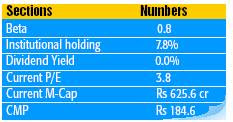
Seamecs scrip is trading at just 3.8 times its earnings for a year now less than twice its book value that makes it a substantially cheaper buy compared to offshore support companies such as Dolphin Offshore, Garware Offshore and Aban Offshore. The company is expected to end 2009 with a net profit of Rs 194 crore, at which the estimated price-to-earnings (P/E) multiple works out to 3.2. On the current asset base, the profit for 2010 is forecast at Rs 165 crore, at which the forward P/E stands at 3.8.
RISK FACTORS:
A stronger rupee or weaker charter hire rates of multi-support vessels could have a negative impact on the companys performance. Also, the company is looking at acquiring another vessel, but the execution of a deal and the deployment of the vessel are uncertain events.
MUMBAI-BASED Seamec owns and operates four multi-support vessels that are used for maintenance of offshore oilfields. French oilfield services and engineering major Technip owns 75% stake in the company, with 13.7% of the equity held by public and the rest held by institutional and corporate investors.
The companys four vessels are currently deployed with Rana Diving from Italy, Indias Dolphin Offshore, Condux SA in Mexico and Dulam International of Dubai.
Seamecs performance in 2007-08 was shaky:
hit by accidents, dry-docking of vessels, rising crew costs and the aftershocks of the global economic crisis on the oil industry. Although partial pressure on charter rates remains, the business scenario has considerably improved in 2009. The companys four vessels have been continuously deployed during the first half of 2009, and the company expects them to be busy till the end of this financial year, boosting its profits. In the last few years, while its peers have been busy leveraging their balance sheets and pursuing rapid growth, Seamec has been highly conservative, preserving cash and staying debt-free .
GROWTH DRIVERS:
Seamec expects to report sizable profits for the quarter ended September 30, 2009, on the back of continuous deployment of its vessels. The company reported a net loss of Rs 12.3 crore in the quarter ended September 30, 2008. It is now scouting for an acquisition for which it has built a war chest over the years. The company has been conserving cash for the purpose it hasnt paid dividend for 12 years now. Seamec last acquired a cable-laying vessel in June 2006.
The company had Rs 63.50 crore in its books for the year ended December 31, 2008, and received Rs 26.40 crore towards insurance claims during the year. When cash flows from operations in the current year are added to these figures, Seamec is expected to end 2009 with a cash balance of about Rs 200 crore. This should be sufficient for the company to purchase another vessel next year without a debt component.
FINANCIALS:
In the last 10 years, Seamecs profits have grown at an attractive compounded annual growth rate (CAGR) of 24.7%, while net sales have risen 10.6%. The company has been debt-free for a few years now. The business of maintaining offshore oilfields also comes with a compulsory holiday every vessels needs to be dry-docked in alternate years which results in additional expenses and loss of revenues. So, a year of higher profits is followed by a year of dip in profits. Since Seamecs balance sheet will record higher profits in 2009, an investor should expect erosion in profits in 2010. If the company buys a new vessel next year, this trend could be arrested.
 VALUATIONS:
Seamecs scrip is trading at just 3.8 times its earnings for a year now less than twice its book value that makes it a substantially cheaper buy compared to offshore support companies such as Dolphin Offshore, Garware Offshore and Aban Offshore. The company is expected to end 2009 with a net profit of Rs 194 crore, at which the estimated price-to-earnings (P/E) multiple works out to 3.2. On the current asset base, the profit for 2010 is forecast at Rs 165 crore, at which the forward P/E stands at 3.8.
RISK FACTORS:
A stronger rupee or weaker charter hire rates of multi-support vessels could have a negative impact on the companys performance. Also, the company is looking at acquiring another vessel, but the execution of a deal and the deployment of the vessel are uncertain events.
DCM Shriram Industries - A Good Small Cap Value Stock With Sugar Play
Belonging to erstwhile DCM Group, DCM Shriram Inds. is a diversified conglomerate with diversified interests in Sugar, Chemicals and Rayon Tyre Cord Fabrics.
1)Company has 12,000 TCD capacity in Sugar Division. It also has cogen power plant of which 12 MW is sold outside.
2)In Chemical Division, Company is producing Extra Neutral Spirit which is supplied to liquour industry. Last year, company installed super distillation plant which enabled it to produce high quality alcohol for premium segment.
3)Company is one of the leading producers of Rayon Tyre Cord Fabrics in India, part of which is for exports.
Rationale for stock recommendation
Due to boom in sugar prices, its sugar division is performing extremely well. Further, despite rise in molasses prices, even chemical division is reporting improved performance due to buoyant demand. Due to huge demand from fast growing Tyre Industry, Tyre Cord Division is also doing extremely well. Company is likely to report all time high profit in 09-10.
Last year, company was in limelight due to aborted takeover attempt by Delhi based brokerage firm.Company has reported extremely good results for year ended March 2009.
1)Topline grew by 43% to 798 crs
2)PAT stood at Rs 39.64 crs (against loss in previous year), turnaround of 44crs
3)EPS stood at 22.78. Stock is trading at 5.18xFY09 EPS
Company has reported Super-fabulous results for Q1:
1. Topline has flared by 50%
2. PBT has zoomed by 6700%
3. Despite big income tax provision, PAT has polevaulted by 13500%.
4. Q1 EPS is 11.60
Conclusion:
At present, sugar scrips have reached very high valuations as sugar prices continue to rise. P.E. Ratio of Sugar Industry is more than 18 due to very high P.E. Ratio (35 for Shree Renuka, 20 for Triveni Engineering) of some bigger players. However, P.E. Ratio of 5 for DCM Shriram is extremely low considering that company has other divisions also which reduces risks associated with cyclical sugar business.
STOCK IS TRADING AT JUST 3.00X FY10E EPS. DEFINITELY THE CHEAPEST STOCK IN SUGAR INDUSTRY.Even if company has a low P.E. Ratio of 6, its share price should be Rs. 237/-, based upon FY10E EPS.Promoters had taken preferential offer at Rs. 90/-.A good small cap stock to buy at dips.
Large Cap Stock To Buy - Engineers India Limited
EIL provides a complete range of project services right from conceptualization, designing and engineering to LSTK projects in diverse fields like petroleum refineries, pipelines, petrochemicals, oil & gas processing, offshore structures & platforms, fertilizers, metallurgy and power.
Company has diversified into infrastructure consultancy area like Urban Development, Airport development, Water Management, Railway Freight Corridor and Intelligent Buildings.
EIL has identified the following growth drivers:
– Internationalise aggressively in existing sectors targeting mid-large sized EPC projects in Brazil, Middle-East, etc
– Nuclear power and Water management
– Solar power and CTL (Coal-to-Liquid) projects
– All existing core areas including hydrocarbon, etc.
Company will be leveraging knowledge / designing / engineering base and project management skills in India and overseas through:
– 50:50 JV with Tata Projects specialized in execution of large projects on LSTK basis, in the areas of power, hydrocarbon, fertilizers, infrastructure etc. in India and overseas.
– 30:70 JV with global leader Tecnimont-Italy (Euro 2 billion) for executing EPC projects in UAE. While EIL will undertake engineering & project management work, Tecnimont would be responsible for construction. With oil prices stabilizing, this JV is expected to get an impetus for orders.
These JVs will further add great value to its core business by diversifying from major reliance on hydrocarbon industry and expanding geography beyond India.
• Current order book is Rs. 8,000 crore divided almost equally (50:50) between Consultancy & LSTK. Export order book – about Rs. 350 crore. Project cycle is 30-36 months. Company expects to maintain at same level of order book by year end (FY2010).
• On LSTK side, margins will be protected, as company is now going more for open-book orders, where input cost increases are passed through.
• EIL has surplus cash of about Rs 2,061 crore, i.e. Rs 367 per share. It has received necessary approvals to develop about 33 acres of land in Gurgaon on outskirts of New Delhi and is currently evaluating different options to maximize shareholders’ value.
Market Cap 5,774.53
EPS (TTM) 69.07
P/E 14.89
P/C 14.49
* Book Value 244.91
* Price/Book 4.20
Div(%) 185.00
Div Yield(%) 1.80
Market Lot 1.00
Face Value 10.00
Industry P/E 20.02
For Q1 FY2010, Revenues grew by 55.1% to Rs 391.4 crore and OPM% zoomed to 25.8% from 17.1%. PAT is higher by 86% to Rs. 94.2 crore. Expected EPS for FY10 is Rs. 80.
In view of very encouraging future prospects, EIL is an excellent investment from a long-term perspective.
Stocks To Buy - Hidden Gems - Taneja Aerospace Aviation
Here is another hidden gem from famous equity analyst Ashish Chugh. He discussed this recently on a TV channel. Ashish Chugh is known to identify the companies with hidden intrinsic value of the stock and recommends to buy stocks at early stage. The stock recommendations from him could prove multi-bagger stocks in long run.
If we see the price pattern of this stock, this stock has been primarily range-bound between Rs 30–40 for a long period of time. Promoters picked-up about 5% of the stake in the company they increased the stake by about 5% in the month of November at about Rs 28 and the stock has been primarily range-bound mainly because of the negatives which surround the sector and also the company. Last year there were rumors of a Delhi based infrastructure company wanting to take a stake in their air strip project and the valuations being talked about are very high, and at that time the stock touched a high of about Rs 250–270.
The company has a 250-acre land where they have made an airstrip which is largely unutilized and I see that as an opportunity, the reason that we are getting the stock at a market cap of just about Rs 100 crore is primarily because of the reasons which are mentioned. When things look rosy and everything starts looking good. When they are fresh with orders for aircraft and the value unlocking which people are expecting that airstrip will have that happens and you won’t get the stock for Rs 35-40.
The reason you are getting the stocks at current valuations is only because of the negatives which are surrounding and the good thing is that the promoters themselves have increased their stake at about Rs 28 in the month of November. At that time there was pessimism all around and the stock has also been range bound for a very long period of time and that’s a reason you are getting this stock for Rs 35, when there were rumours of someone big buying that airstrip business and fancy valuations being talked about at that time the stock was not available for Rs 35 and it was available for Rs 250–270. So this is the one for the patient investors who can just sit on the stock and wait for company to unlock the value for the shareholders.
Subscribe to:
Posts (Atom)